

The homework that ran itself
Hackers stole about $6.4 billion from Binance, the crypto exchange, on 29 October 2026. [6] That is more than four times the previous record, the $1.5 billion taken from Bybit in February 2025. The FBI says North Korea was behind both. [1] [12]
It started in September. Someone posing as a “project director” contacted one of Binance’s software engineers on a job site (LinkedIn, according to Fortune). He had a first interview on video with the company’s HR person, then a second with its “CEO” in a chat app. The recruiter, the HR person, the CEO and the whole company were fake. [2] [3] [5]
The “CEO” asked him to download a coding assignment. On its own, that is a normal thing to be asked in a tech interview. But he was at his work laptop, and Binance’s account, reported by The Register, says “the code executed on his work computer during the setup process”. Getting the homework ready was enough. [2] [3]
Setting something up can run code because of how projects are installed. A JavaScript project usually starts with one command, npm install, which downloads the packages the project depends on. Any of those, or the project itself, can carry install scripts: commands that run the moment it is installed, with the rights of whoever installs it. Nobody has to type their names. [15]
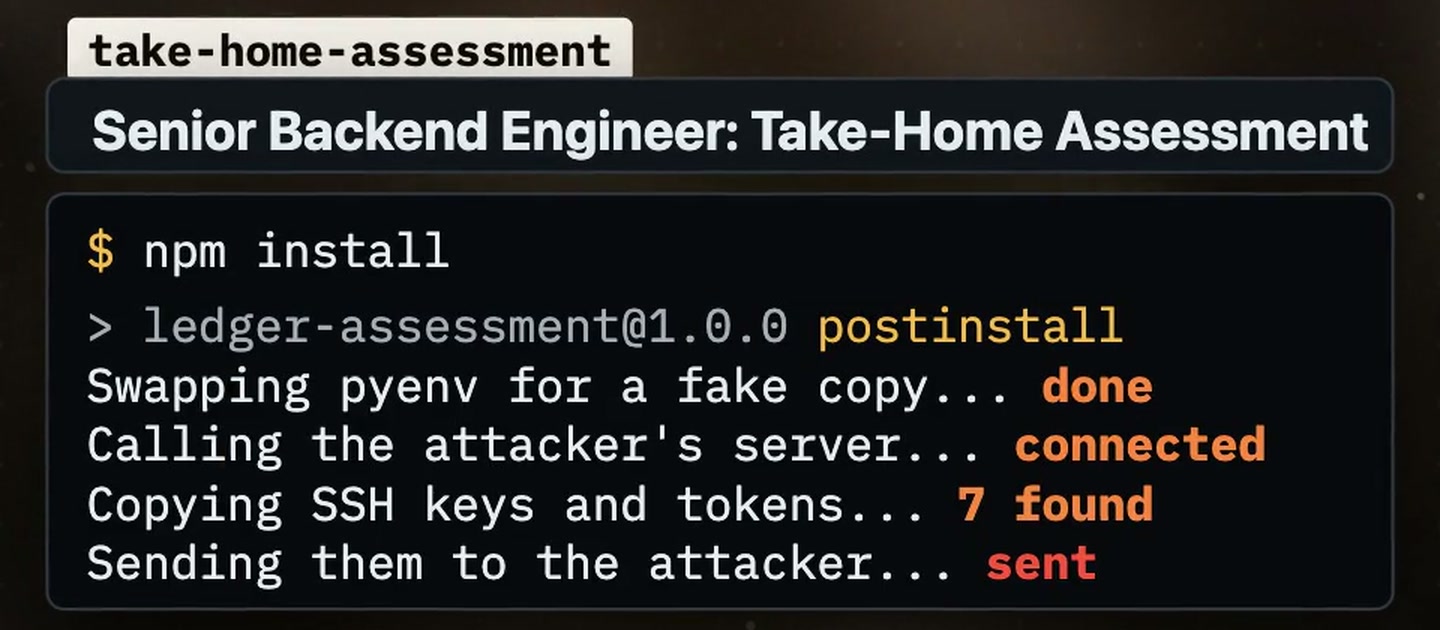
- The step everyone runsStep two in the test’s README, straight after downloading it. It looks like housekeeping.
- A script nobody asked forpostinstall tells npm to run a script as soon as the install finishes. This is where the attack lives.
- What it doesThe first two lines follow Binance’s account. The last two show what that access is for: keys and tokens that open other systems.
No report says what kind of project the real assignment was. Binance says its malware swapped pyenv, a tool developers use to switch between versions of Python, for a malicious copy, then connected to a server the attackers controlled. [2] [3]
Months to get in, under four hours to take it
The engineer’s laptop was only the way in. On 20 October, nine days before the theft, the attackers used it and one of Binance’s internal AI tools to get into two more employees’ computers. One of those held a permission that let them start software inside Binance. With it they took over the wallet-signing service: the system that approves money leaving Binance’s hot wallets, the crypto it keeps online. [2] [3]
Binance says the campaign began even earlier. In June another engineer on the wallet team clicked a malicious search ad and installed a tampered copy of Homebrew, a tool for installing software on a Mac. Binance caught that one and replaced his laptop, but says his role and his colleagues on the wallet team were exposed to the hacker. [2] [3]
On Thursday 29 October the signing service signed the attackers’ payments. The on-chain transfers are publicly recorded. [7] [9]
- 8:05 pmFirst money out, on the XRP Ledger
- 8:24 pmThe main Ethereum transfer: about 167,464 ETH and 63 other tokens in one transaction
- 11:56 pmThe last Ethereum transfer
- In all3 hours 51 minutes from the first transfer to the last
TRM Labs reports that most of the theft took place in about twenty minutes. [7] Either way, it took months to get in and under four hours to take the money. Chainalysis calls it the largest theft in crypto history. [6]
Where the money went
By 07:30 UTC on 13 November, Elliptic had tracked the stolen funds through almost 27,000 wallets. A wallet here is just an address that holds crypto. Splitting the money thousands of ways is part of laundering it, and Elliptic says the process was clearly automated. [8]
Some of it can be frozen. Stablecoins such as USDT and USDC are issued by companies, Tether and Circle, that can freeze them. By 11:30 am Eastern time on 3 November, about $2.8 billion had been frozen by Tether, Circle, Ripple, Arbitrum, Optimism and law enforcement, according to Chainalysis. [6]
Bitcoin has no issuer to ask. TRM Labs counts 18,270 bitcoin, about $1.47 billion, beyond any issuer’s reach. That is the rounded $1.5 billion in the video that can’t be frozen by a token issuer. [7]
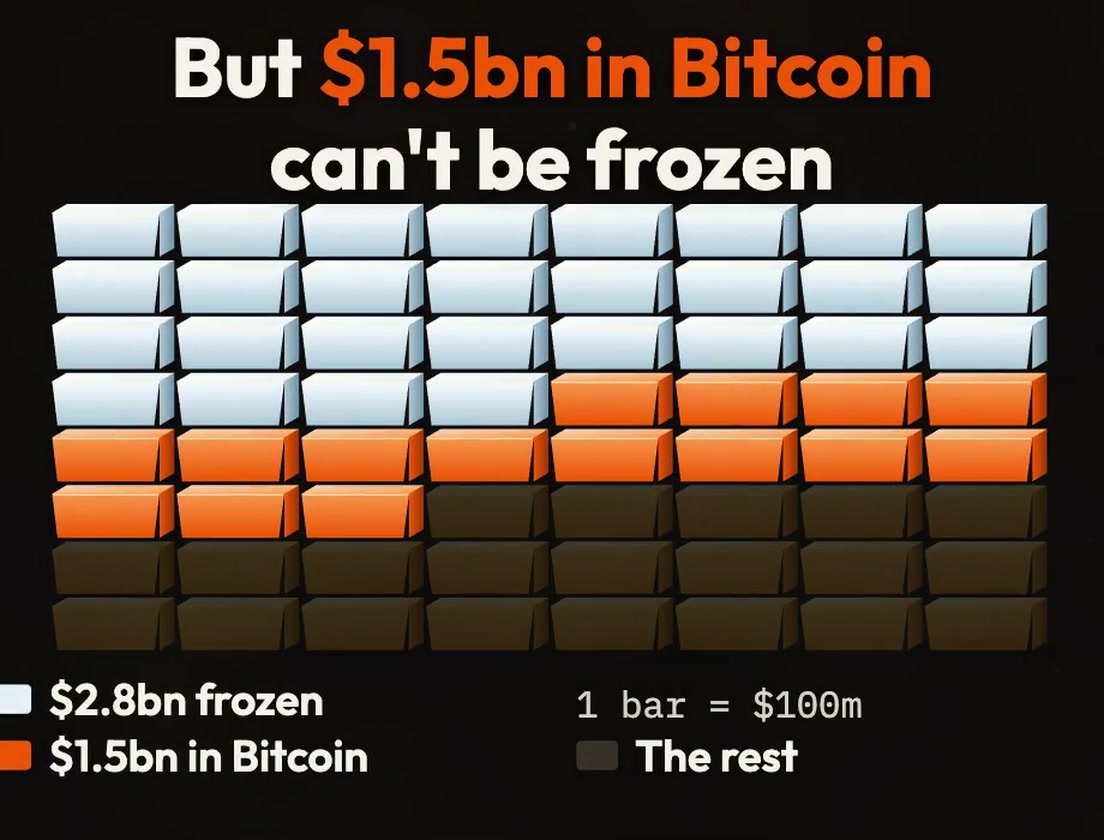
Binance says it will cover every loss, and that user funds are safe. [2] [10] North Korea denies any part in it. [11]
What stops it at work
The FBI warned about this kind of recruitment attack in September 2024, in a public service announcement about North Korean groups targeting crypto companies. It advises against running interview tests or code on company devices. If a test needs code to run, it says to use a virtual machine (a separate computer running inside another one) on a device that isn’t connected to the company, or a device provided by whoever set the test. [14]
For moving money, it tells firms to “require multiple factors of authentication and approvals from several different unconnected networks”. [14] Binance says the attackers compromised its wallet-signing service; its public account does not establish every approval control that was in place. [2] [3]
Developers can also stop npm running install scripts automatically. With its ignore-scripts setting on, in npm’s own words, “npm does not run scripts specified in package.json files”. It isn’t a fix on its own: npm’s documentation says commands such as npm test still run the script they name, so code you don’t trust still belongs on a throwaway machine. [15]
npm config set ignore-scripts trueIf a recruiter sends you code
- Don’t run it on your work laptop, or on any device your employer owns. That includes “just setting it up”.
- If a test really needs code to run, use a virtual machine on a device that is not connected to your company, or a device provided by the company hiring you.
- Check the people are real some other way, through a channel you find yourself, not one they gave you: the company’s own website, or someone you already know there.
- Treat these as warning signs, all from the FBI’s list: being asked to run code or install an app on a work device, a “pre-employment test” or debugging exercise, a job offer you didn’t expect, and a request to move the chat to another messaging app.
The steps follow the FBI’s public service announcement I-090324-PSA, 3 September 2024. It was written about North Korean groups, but the same trick works for anyone. [14]
What this doesn’t prove
Written from the public reports listed under Sources, checked 13 Nov 2026.
- How the attackers got in is Binance’s own account, published on 3 November 2026. We have not independently verified that account, and details may still change. [2] [3]
- The amount depends on who counts and when: about $6.4 billion (Chainalysis), about $6.3 billion (Binance), $6.36 billion (TRM Labs) and “more than $6 billion” (FBI). [1] [2] [6] [7]
- The frozen total and the wallet count keep moving as tracers find more. The video used an earlier wallet count; Elliptic’s update at 07:30 UTC on 13 November reported almost 27,000 wallets. [8]
- “Under four hours” runs from the first transfer to the last. TRM Labs reports most of the theft took place in about twenty minutes. [7]
- The coding test on screen is our own example. The real assignment hasn’t been published.
- Why the antivirus didn’t stop it is Bradley’s assumption. Binance hasn’t said.
Go deeper on our wiki
Sources
- North Korea Responsible for $6 Billion+ Binance AttackFBI, 31 Oct 2026
- 29 October Binance Security Incident: Initial Findings and Response UpdateBinance, on X, 3 Nov 2026
- North Korean fake job interview led to $6.3B Binance heistThe Register, 3 Nov 2026
- A Binance engineer thought he was interviewing for a job. Then the hackers pouncedNPR, 3 Nov 2026
- North Korea used LinkedIn, fake job interviews to trick Binance engineerFortune, 3 Nov 2026
- The $6.4 Billion Binance Hack: Tracing the North Korea LinkChainalysis, 30 Oct 2026, updated 3 Nov
- North Korea Steals USD 6.36 Billion From Binance in the Largest Hack in HistoryTRM Labs, 29 Oct 2026
- How North Korea is laundering the $6.4 billion stolen from BinanceElliptic, 3 Nov 2026, updated 13 Nov at 07:30 UTC
- The main Ethereum transfer, block 26300770Etherscan, 29 Oct 2026
- Binance says $6.3bn stolen in biggest crypto heist in historyAl Jazeera, 30 Oct 2026
- Sister of North Korea’s Kim slams FBI’s Binance hack allegations as “grave” provocationSouth China Morning Post
- North Korea Responsible for $1.5 Billion Bybit HackFBI, 26 Feb 2025
- Biggest Crypto Hacks of All TimeDecrypt, 2 Mar 2025
- North Korea Aggressively Targeting Crypto Industry with Well-Disguised Social Engineering Attacks (I-090324-PSA)FBI, 3 Sep 2024
- Config: ignore-scriptsnpm Docs