
Skip to content
All services

Security Roadmapping

Penetration tests, audits and internal reviews often leave separate backlogs with different scoring. We reconcile them, look at your external endpoints, configuration and recent incidents and alerts for ourselves, work out why the same findings keep appearing and agree a realistic sequence of fixes that remove the cause.

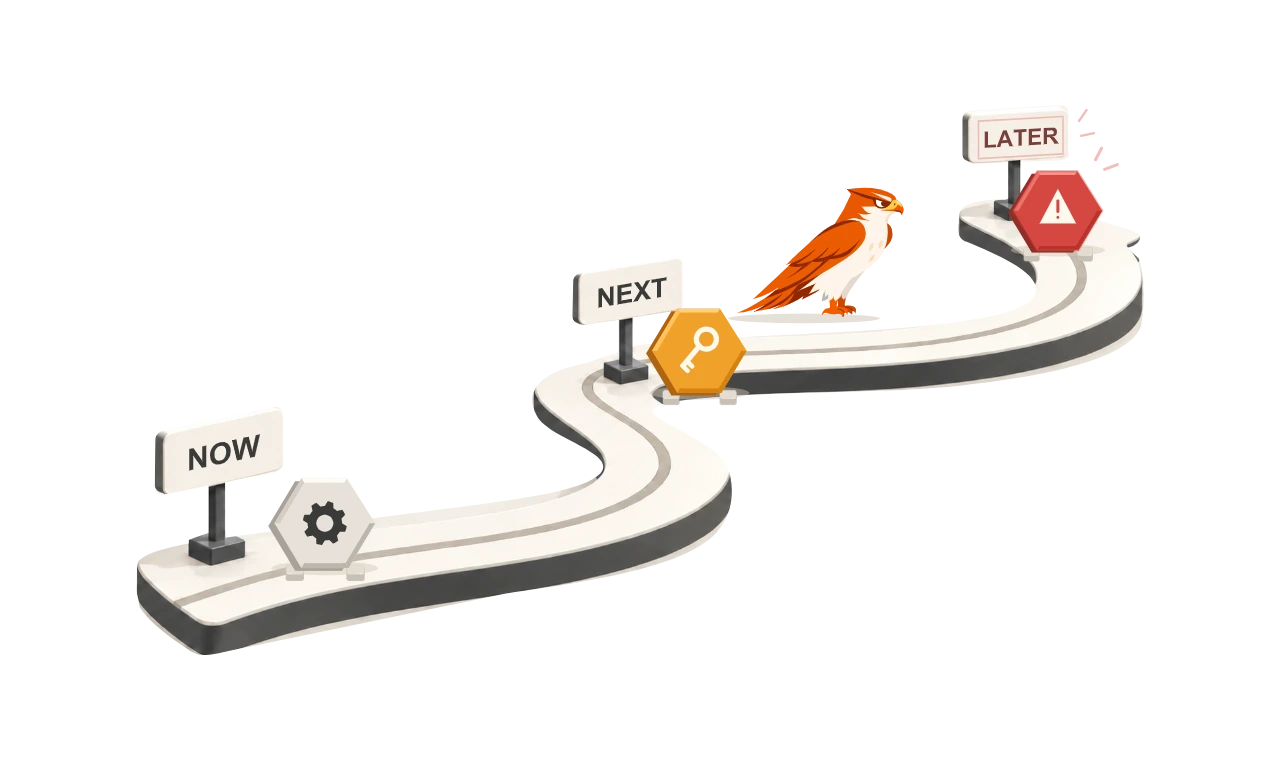
The eagle moves an urgent improvement to Now and lights the route through Next and Later.

Who this is for

Security teams carrying more findings than they can address at once, or leaders who need a defensible plan for the next six to twelve months.

  • You have more findings than the team can address at once.
  • Several reports overlap and their priorities conflict.
  • Leadership wants a defensible plan for the next six to twelve months.
Common scenarioSeveral reports contain overlapping recommendations, priorities conflict and the team needs to decide what can be delivered this quarter with the people available.
Incoming reports
Pen test report23 findings
Compliance audit15 findings
Vulnerability scan87 findings
Bug bounty triage8 findings

What the evidence says

Independent findings from the last year, with the report each one comes from.

  • 43%of UK businesses identified an attackSource: DSIT
  • Under 5%of exploited flaws spread widelySource: Cyentia

What the evidence says

Independent findings from the last year, with the report each one comes from.

Phishing is the symptom almost every UK business sees

85%

of UK businesses that identified a breach or attack in the last year experienced phishing, the most prevalent and most disruptive type. Just over four in ten businesses (43%) identified an attack at all.

85 in every 100 breached businesses saw phishing

This is why a flood of phishing reports is treated as a symptom and traced to the control that let it through, such as an allow list or a gap between the mail gateway and Defender, before anyone buys more training.

Most vulnerabilities are never exploited, so severity is the wrong sort order

6%

of all published vulnerabilities have ever been observed being exploited in the wild, and fewer than 5% of those reach more than 1 in 10 organisations.

6 in 100 CVEs
Share of published vulnerabilities ever seen exploited

This is why the roadmap does not sort by CVSS. A run of findings on public facing apps points to the missing control, such as no DAST or SAST in the pipeline, and fixing that becomes the next step.

Critical backlogs are growing faster than they are fixed

50%Only 26% fully fixed

more critical vulnerabilities to patch in the median organisation than the year before, while only 26% of those known to be exploited were fully fixed and the typical fix took 43 days.

Typical time to fully fix a known exploited critical vulnerability

This is why the plan sequences work by root cause and by the capacity you actually have, so the same class of finding stops reappearing in next year’s test.

How the engagement runs

  1. Gather the evidence

    Collect existing reports, test results, audit findings and backlogs, then look for ourselves at your external endpoints, configuration and recent incidents and alerts.

  2. Reconcile the findings

    Map the different rating schemes into one structure, remove duplicates and identify recurring causes.

  3. Add business context

    Consider the affected service, likely impact, architecture, current controls and delivery capacity alongside technical severity.

  4. Sequence the work

    Group related fixes, record dependencies and agree realistic milestones for each quarter.

  5. Explain the choices

    Present the recommended order with the evidence and tradeoffs needed for leadership approval.

Why we work this way

  • Findings are symptoms, and the roadmap names the cause

    A run of vulnerabilities on public facing apps usually means nothing scans code before release. A flood of phishing usually means a control is letting it through. Each recurring finding is traced to the control or process behind it, and that is what goes on the plan.

  • Technical severity is only one input

    A lower severity issue on a payment system may deserve attention before a critical issue on an isolated test service.

  • Capacity changes the plan

    A roadmap must fit the people, budget and dependencies available, otherwise it becomes another unused backlog.

Symptom to fix3 examples
What you seeRepeat findings on public facing appsControl gapNothing scans code before releaseOn the roadmapDAST and SAST in the pipeline, then a targeted pen testClears 31 of the 74 unique findings
What you seeA flood of phishing reportsIntegration gapAn allow list bypasses the gateway and Defender never sees itOn the roadmapFix the mail flow and tune the filters before more trainingStops most phishing before it reaches an inbox
What you seeThe same misconfigurations every reviewProcess gapNo baseline and nothing watching for driftOn the roadmapPolicy as code with an alert when a setting changesKeeps 12 findings from returning at the next review

What you receive

A prioritised roadmap with owners, dependencies and quarterly milestones, each step tied to the root cause it removes, supported by an executive summary and the scoring behind each decision.

  • Aggregation of all existing reports, pen tests, and audit findings
  • Our own checks of your external endpoints, cloud and mail configuration, and recent incidents and alerts
  • Deduplication and normalisation across sources
  • Root cause analysis of recurring findings, from missing pipeline scanning to phishing controls that let mail through
  • Risk scoring based on your business context
  • Sequenced roadmap with effort, impact, and quick wins
  • Executive summary for leadership and board reporting

Sample report, fictional client

Cover1 / 5
Pages in this sample

Why choose us for this work

  • Experience running security programmes

    Our consultants have owned internal security backlogs and understand the constraints behind delivery.

  • Patterns reviewed across reports

    Repeated findings are traced back to the underlying process or control so the roadmap addresses the cause.

  • A plan leadership can review

    The roadmap gives delivery teams enough detail to start work and gives leaders the reasoning behind the priority.

Planning this work?

Talk to our team about Security Roadmapping

Book a consultation